Forest rain and bird chirps in Paranoid Park

Paranoid Park by Gus Van Sant was the opening movie at Cinepur CHOICE film festival in Brno in 2008. From all of the movies I watched there, it had the biggest emotional impact on me. The story is simple, but it is told beautifully and there is a lot of great examples of cinematic storytelling to look at.

One of my favorite scenes is definitely the shower scene. It takes place after an accident at train tracks, where Alex, the main protagonist of the movie, kills by mistake a security guard.

This would be a harrowing experience for anyone, and especially for Alex, who is just 16 years old. He is really confused, struggling what to do, thinking, if he should call somebody and say what happened.

That night, he doesn’t go home, but stays at his friend’s house. He takes off his clothes and puts it in a black plastic bag. After that, he goes to the shower.

Paranoid Park (2007)

The whole shower scene was shot in slow-motion and in close-up. Close-ups have the ability to make us feel as though we are experiencing everything through the point of view of the character. That means, we can get inside their head and experience what they are experiencing.

For sound designers, this is a great opportunity to play with the sound, especially in this case, where they can get into a mind of a 16 year old teenager, who killed a man.

So when we get into the shower, we’ll hear at the beginning only simple water drops, but this changes very soon. In a moment, we’ll hear some kind of processed bird sound (I might be totally wrong here), which rises constantly in the pitch. Meanwhile, the sounds of water drops change into a heavy forest rain. Then you can clearly hear bird chirps – notice the bird tiles in the background – and after a while, you’ll hear all sorts of other bird sounds. All of the sounds are slowly rising in their intensity and volume. So what we are hearing in this scene, describes perfectly the troubled state of mind of our main character.

I didn’t have the opportunity to read the original script, but I’m almost sure, that it was all scripted, including the bird tiles in the background.

Great screenwriting, great directing, great scene. What else to say? Perhaps only, choose carefully what tiles you’ll have in your shower cubicle, just in case…

Camera as a victim in Irréversible

Irréversible, a movie by Gaspar Noé, was the first film at Cannes Film Festival, to be screened after midnight. Now, that gives you an idea, that there is something unsettling about this movie.

There is one of the most brutal and violent scene I’ve ever seen, not only in terms of the content, but also in the way the violence is portrayed.

The scene starts, when Alex (played by Monica Bellucci) leaves a party and walks home – alone. She goes through the underground walkway, where she runs into a brutal ravisher named La Tenia.

Alex is than threatened with knife, brutally raped, beaten and humiliated. The whole scene takes 13 minutes (with no edits), from which 9 minutes is the raping itself. The scene is really difficult to watch, you’ll feel uneasy, angry, desperate and you’ll feel all sorts of other emotions, which are hard to describe by words.

One of the reasons, why the scene has such strong emotional impact, is the placement of the camera.

Irréversible (2002)
Irréversible (2002)

If you look at the picture above, you can see, that Alex is stuck, lying on the ground and unable to move. Here we can draw some similarities with the camera position:

The whole scene is captured from one angle, the camera is not moving, there is no tilting, no panning, no movement at all. The camera is very low, it is basically sitting on the ground, also stuck at a dead position, helping thus convey (at least partially), how she feels.


I also thought about other camera positions, how it would change the meaning of the scene. Here is what I came up with:

  • Hand-held – Imagine, that the scene would be captured from above and that the camera could freely move. In that case, the camera would share the point of view of the ravisher, identifying thus with him.
  • Distanced – If the camera was far away, emotionally, we wouldn’t be as much involved. This camera position could be somebody else’s point of view, who sees everything from distance, who acts there only as an observer. (And there is actually somebody else for a while, who sees everything, but runs away and does absolutely nothing to help her.)
  • Two and more cameras – Other option would be to cover the scene from many different angles, which would give us some opportunities in the editing process – to stylize the whole scene, create different meanings or create total chaos.

I’m sure, that there are other possible camera positions with new meanings. If you have any, I’d be pleased to read them in the comments below!


Back light in Toy Story 3

Toy Story 3 (2010)
Toy Story 3 (2010)

One of the most basic, and at the same time, most effective way to light a character or object in a scene, is using a three-point lighting setup.  This setup is used extensively by photographers, filmmakers or CGI artists. But as you’ll see in this example, creative use of the three-point lighting method can be used also as a storytelling device.

Three-point lighting

Three-point lighting

Let’s quickly describe, what the three-point lighting method is all about.  As the name suggests, we’ll be using three lights: key light, fill light and back light. Let’s start with the key light.

Key light
Key light

Key light is our main source of light. It is the brightest light, which defines the overall direction, angle, color and strength of light and shadows in the scene.

Fill light
Fill light

Fill light shines at the subject from the same side, but at a different angle. It has lower intensity than the key light and its main function is to “fill in” the harsh shadows, created by the key light.

Back light
Back light

Back light, a.k.a. rim light, shines at the subject from behind, creating a light wrap around character/object’s contours, helping thus separate the character/object from the background.

It is also clearly visible, that back light, due to its position, hides the character/object in shadows.

Emotional meaning of shadows:

Everybody will associate different meanings and assign different values to that word, so in the following sentences, I’ll try to describe, what it means to me.

  • The first association is something dark, something bad and evil. The dark side of your personality, that nobody should know about.
  • Secondly, it may represent your wrongdoings, or demons haunting you for the bad things, you did in your past.
  • Next, shadows are kind of mystery, they impose more questions than answers.
  • And lastly, shadows may portray evil intentions or plans.

Buzz versus Lotso

Toy Story 3 (2010)
Toy Story 3 (2010)

The scene starts, when the daycare closes. (Notice the lighting in the scene, telling us that it’s a late afternoon!) Andy’s toys are tired, exhausted and frustrated, because their first playtime in the daycare was a lot different from what they were looking for.

Therefore, Buzz decides to go to visit Lotso (local boss) and talk with him about moving him and his friends to the other room, where they’ll be treated much better.

Toy Story 3 (2010)
Toy Story 3 (2010)

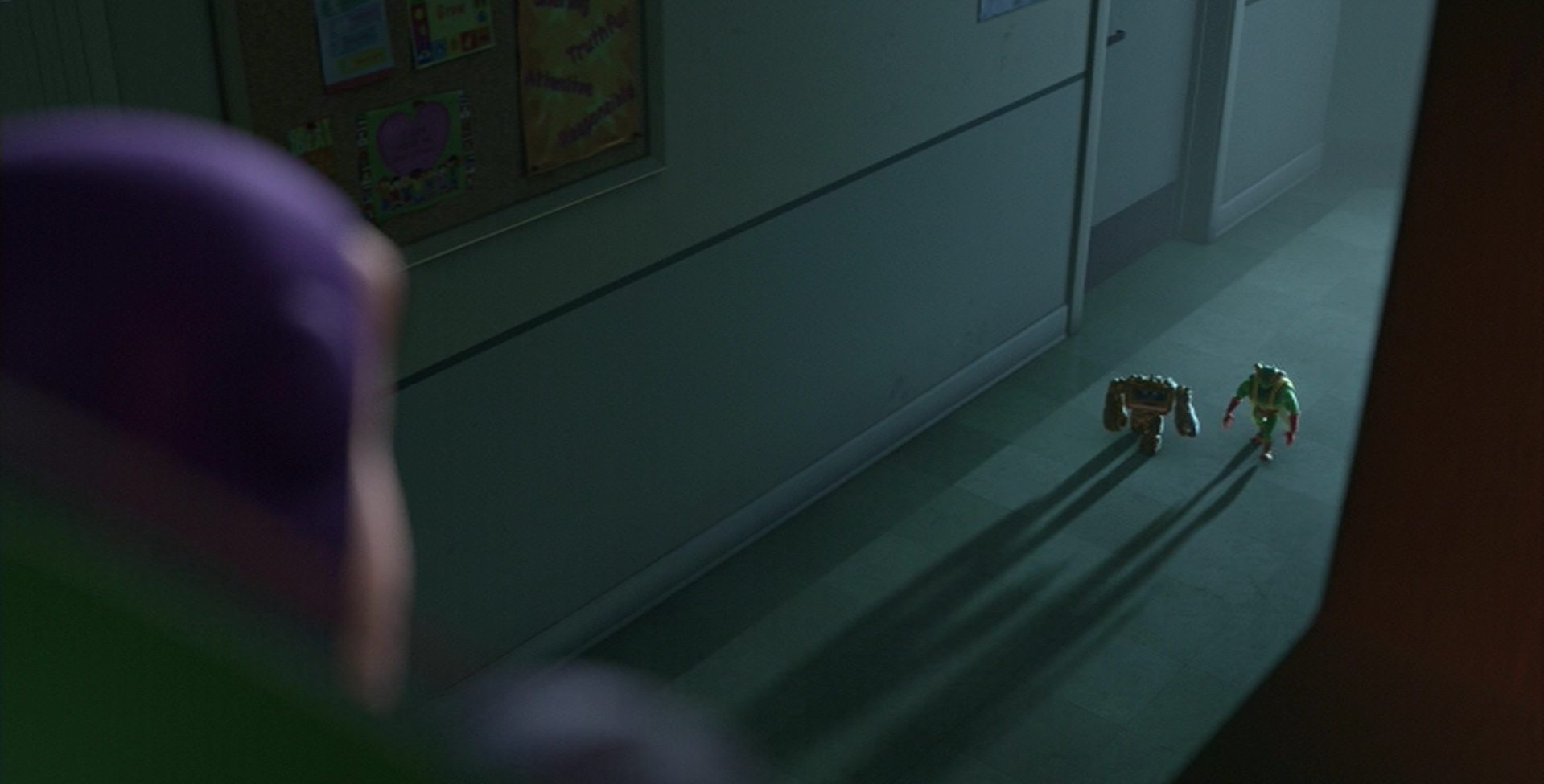
On his way to Lotso, he has to pass several obstacles and guards. Now, notice the long shadows of the guards in the picture above, caused by the back light. I don’t know what exactly they mean, but on emotional level, it tells me, that these guys are bad.

Continuing on the way, Buzz enters the vending machine, but gets caught later by a big doll baby. He is then moved to the library, when he finally meets Lotso. They have a short argument, after which Lotso decides to reset Buzz, by switching him from the play to demo mode.

Toy Story 3 (2010)
Toy Story 3 (2010)

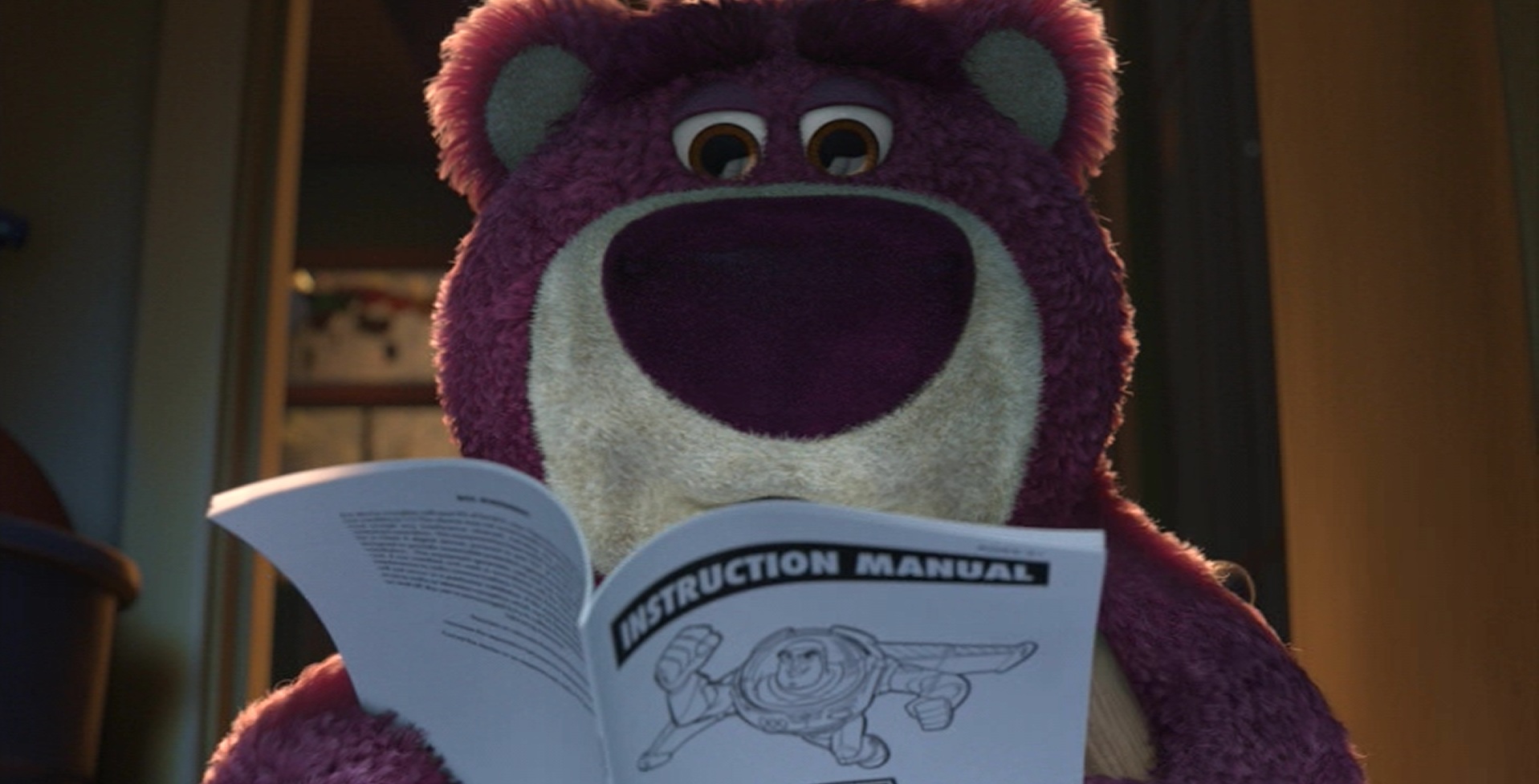
In the picture above, we can see Lotso reading the manual, searching for instructions, how to reset Buzz Lightyear to the original factory settings.

What is really exciting here, is the lighting of the scene, primarily the lighting of Lotso. The back light creates nice light wrap (rim) around his contours, but most importantly, because of the missing key and fill light, Lotso’s face is in the shadow.

Again, emotionally, it really works for me. It shows the dark side of his character and his bad intentions with Buzz.

I can’t wait to watch the movie again and search for other examples of cinematic storytelling. I love you Pixar!


Other examples:

South Park, Season 10 - Episode 7
South Park, Season 10 – Episode 7
The Iron Giant (1999)