I love when certain technique gets used on purpose – when it is used not only because you can, but because it helps to tell the story, and color contrast enhancement (CCE) in Seven is exactly that case.
Detective William Somerset (Morgan Freeman) is at the end of his career, but he gets one last case to solve, together with young detective David Mills (Brad Pitt), he is searching for serial killer John Doe (Kevin Spacey), who kills his victims on the basis of seven deadly sins.
The overall atmosphere of the movie is literally dark. First, the serial killer John Doe is brutal and fanatic, but at the same time, he is very clever, intelligent and accurate – I can hardly imagine worse villain than him (Joker from Batman gets honorable mention here). Second, most of the scenes happen in dark interiors, in certain scenes, you’ll see only flashlights of the detectives.
Se7en (1995)
But outside it doesn’t look any better. Dirty, violent and depressive city, where it constantly rains.
Se7en (1995)
To further support this dark mood and atmosphere, some theatrical prints were created using silver retention process. This technique increases the contrast – it makes dark areas darker and light areas lighter (similar to blending mode overlay). In other words, the blacks are more black. Further, this technique adds more grain to the film print. Maybe you haven’t noticed this effect at first (I haven’t), but you can certainly feel it on emotional level. So long story short – CCE increases the contrast (drama) and grain (roughness).
P.S. I’m almost 100% sure, that the director David Fincher and cinematographer Darius Khondji discussed the CCE technique before they shot the movie. This only proves, that David Fincher knows how to tell a story in a cinematic way.
Hong Kong cinematographers have a neat saying about shaky camera: “The handheld camera covers 3 mistakes: Bad acting, bad set design, and bad directing (1).” However, in certain cases, the shaky (handheld) camera can be used to tell a story, instead of covering the mistakes.
Paul Greengrass (director of the Bourne trilogy) certainly didn’t invent the shaky camera, but he definitely popularized this technique. If you’ve seen the Bourne trilogy, you’ve probably noticed, that the camera almost never stops moving. But there is always a good motivation behind this movement.
Motivation for shaky camera in 4 points
1. World he lives in
Jason Bourne (the main character) is constantly on the run, chasing or being chased by somebody, escaping from somewhere, looking for or protecting somebody. The shaky camera helps to portray the world he lives in – fast paced erratic world.
2. His inner conflict
Additional motivation for the shaky camera comes from his inner conflict – he doesn’t know who he is, what he has done and why, because he suffers from amnesia. This certainly adds to the shakiness.
3. The way his mind works
At certain point there is a dialogue scene between Jason Bourne and his former collegue Nicky Parsons. The camera is constantly moving, which would be really annoying in “normal” dialogue, but in this case, it’s perfectly ok. It shows how his mind works. Even if they are just talking, he is always alert. He is checking the escape routes, looking for people who might be dangerous etc. His mind never rests, and so does the camera.
4. Shaky cam as a stylistic choice
Finally, shaky camera was a stylistic choice. In action scenes, (together with fast editing) it injects energy to the scene, creates chaos (which is sometimes desirable) and in a sense, it may add more realism and authenticity to the specific scene.
When it bothers me and why
Unfortunately, the shaky camera became really overused. Sometimes, I am watching a (dialogue) scene and the camera is constantly moving and that really annoys me, because I can’t figure out, what was the motivation behind it (and I don’t count covering mistakes as a good motivation).
Second reason why it bothers me is that it takes away from the actor’s performances, if the camera is always moving, I just can’t pay attention to them (because I’m trying to figure out, why the camera is moving).
Finally, making the camera steady is far more difficult than making it shaky. That being said, shaky camera will always look cheap to me, unless it is used on purpose, to tell the story.
Also, when I did my research on this topic, I’ve found, that it makes certain people physically sick and spoils the movie for them.
Anyway, I wouldn’t say that shaky camera is necessarily a bad thing, but it can be really annoying if used randomly and without any purpose. If you haven’t watched the Bourne trilogy yet, or if you are looking for good examples of shaky camera, watch the story of Jason Bourne.
“The truth is the best stuff evolves when I don’t really think about it. The good ones just come naturally…” [Andrew Mohrer]
Downpour by Andrew Mohrer
Few weeks ago I received through email inspiration several photos by Dj Poe (Andrew Mohrer, New York based photographer). And I was absolutely amazed. Usually, I move the emails right away to my email inspiration folder, but not this one. I couldn’t stop looking at the pictures. They were absolutely stunning, they looked like they were taken from a movie! In other words, they felt really cinematic.
Recently I was wondering, how would you actually define the word cinematic? (I guess I should know, since I’m writing a blog about cinematic storytelling.) So I decided to go back to that email and tried to answer, what does the word cinematic really mean to me.
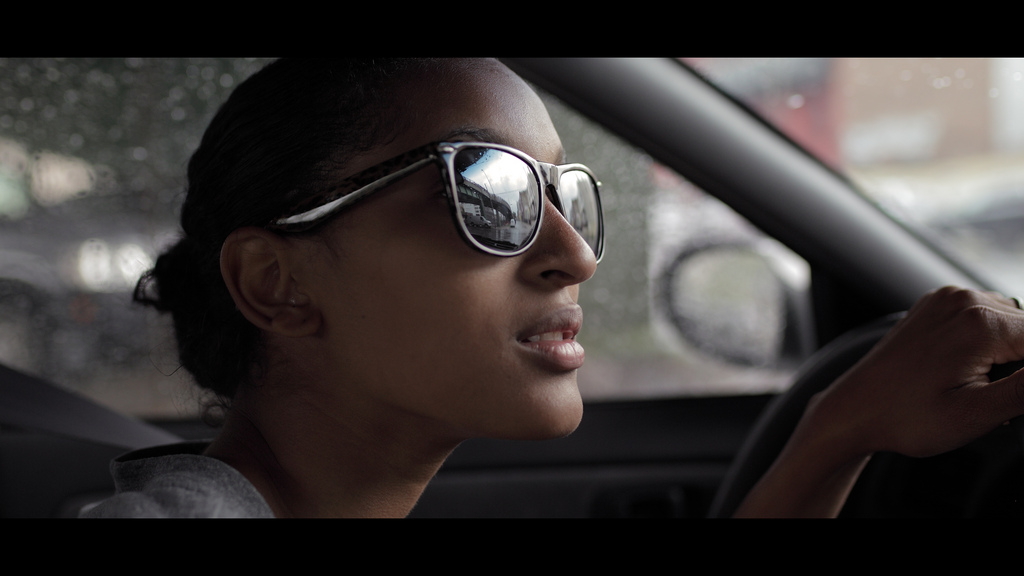
Vanessa by Andrew Mohrer
Looking at the picture above, we can see that there is a shallow depth of field, the image has widescreen aspect ratio (plus the black bars at the top and bottom), the colors are desaturated, the lighting is great and the composition is perfect as well.
The problem is that you can find thousands of pictures like this on the internet, books or magazines with shallow depth of filed, desaturated colors etc. And yet, most of them won’t feel cinematic at all.
So what I think makes the photos by Dj Poe really cinematic is their ability to make you ask questions. The most obvious question in this case would be: Where is she looking at and why? You can come up certainly with many other more or less relevant questions like:
What car is she driving?
Is it her car? Is she a driver by occupation?
Is she waiting at a crossroad for a green light?
Is she waiting for someone?
What is going to happen next etc.?
But the point here is not what kind of questions makes the image ask you, but the fact itself, that it DOES make you ask those questions.
Making the viewer ask questions is a very powerful cinematic technique, because it makes the viewer involved, and that happens when there is a certain kind of mystery, a space for your (viewer) interpretation.
That’s the difference between evening news (basically random shots, no need for interpretation) and movies by Stanley Kubrick (every shot is a very well composed shot with layers of meaning).
What I think is great about this definition of the word cinematic, that is
adding additional layers of meaning
making viewer involved by asking questions
ability to create a story in viewer’s mind
is that it’s applicable not only to photos, but to music, visual effects, sound design, you name it. The point is: Great art poses questions. So leave a space for an interpretation of your work, would you? 🙂
Jun 11, 2012
Andrew actually read this article, look what he wrote under one of his photos Caught The Eye.
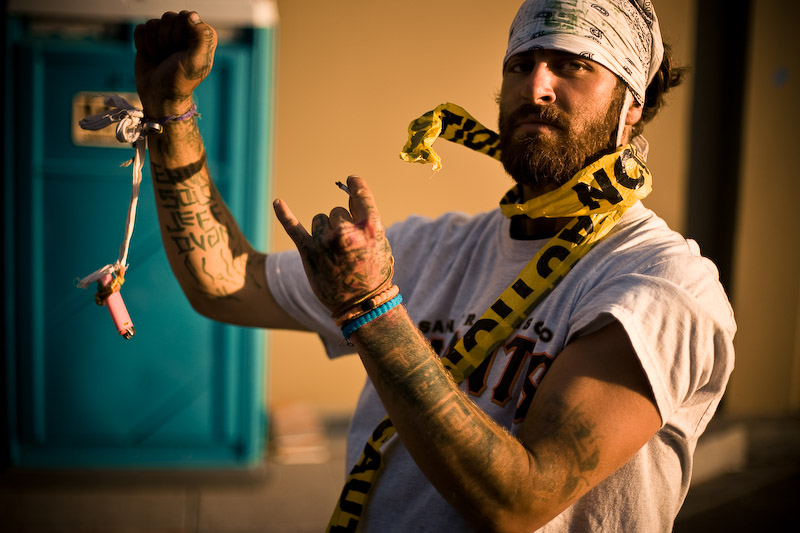
The fact, moment and light are 3 zones he thinks about when taking a photo. He firstly describes each zone individually and then concludes, that best photos occupy the intersection of all three zones. At the end, he shows an example of such photo (FML shot).
FML shot by Stu Maschwitz
But here comes the best part! Not only it is a FML shot, but it made Stu ask questions!
Is that a joint in his hand?
Is it so important that he keep it lit that he’s tied a lighter to his wrist?


 CINEMA SHOCK