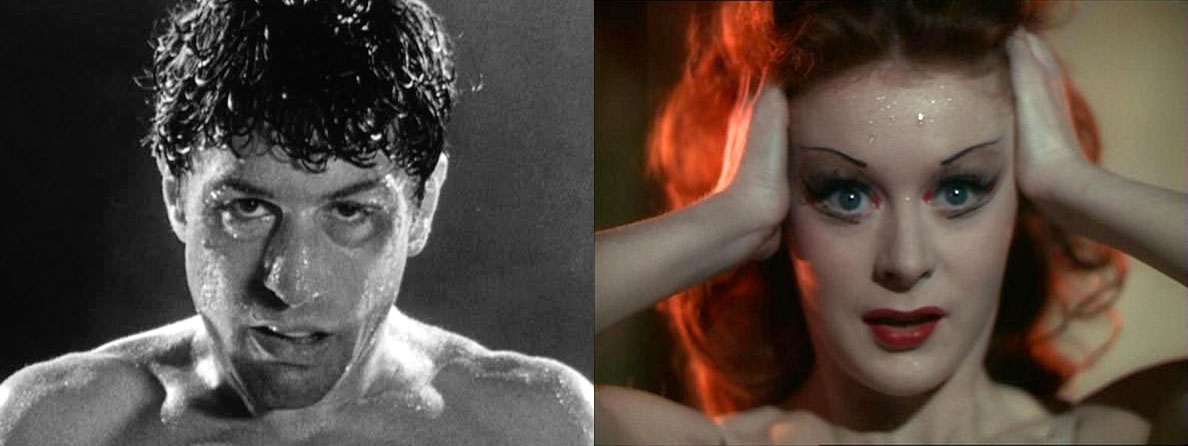
The standard way of shooting a ballet scene, up until 1948, would be to photograph the dancers from head to toe. However, Red Shoes – photographed by Jack Cardiff – completely changed this. The movie is photographed in such a way, that we’ll see what goes on inside the dancer’s head – we are shown what they see(=their POV). (And there is nothing better than POV when it comes to sound design, but wait! 🙂 )
Few years later, Martin Scorsese applied this in boxing scenes in Raging Bull. If you pay attention, you’ll notice, that the camera stays always inside the ring. Watch the video below to see a comparison of ballet and boxing scenes in Red Shoes and Raging Bull (taken from the documentary Cameraman: The Life and Work of Jack Cardiff):
The similarity is clearly visible. But Martin Scorsese took this concept even further.
POV and Sound Design
The POV shots are amazing opportunity for sound designers – the POV gets us inside the head of the character. That means, that we see what they see, but also hear what they hear! And this is extremely exciting, because you can, as a sound designer, play with the sounds what they hear. Being inside the head of the character gives you license to distort and manipulate the sounds.
Frank Warner, the sound designer of Raging Bull, created whole library of sound effects, that you’ll hear during the boxing scenes. These include: Smashed watermelon and tomatoes, animal like noises, gunshots(these were used for the sound of camera flash bulbs going off) and many others. (Sound mix for Raging Bull took six months!)
I can only guess, what sound effects were used in the boxing scenes, but the truth is, that even Martin Scorsese doesn’t know. Frank Warner was so protective about his sound effects, that he destroyed them later, so nobody else could use them again.
Anyway, POV shots are brilliant for sound design. Especially for self-destructing characters like Jake La Motta.
Plus, the boxing ring in itself creates an attractive environment for sound design. I think everyone would be interesting in terms of sound design when standing inside the boxing ring, not just Jake La Motta. In boxing ring, you just see and hear differently, trust me.
In January 2012, I wrote a post about POV and sound design, you can read it by clicking here.
Emma Coats, former story artist at Pixar, recently tweeted a link to this commercial as an example of visual storytelling. Watch the commercial in the video below:
So far, I’ve been writing about cinematic storytelling (with one exception) using various movies as examples. However, cinematic storytelling doesn’t apply only to the movies, it has its place also in video games, music videos or TV commercials.
POV shot
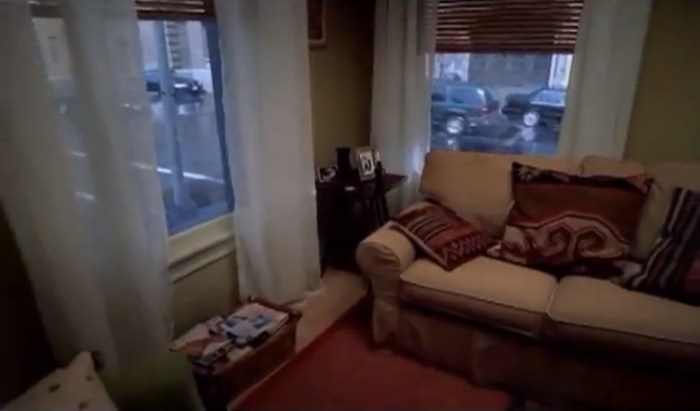
The IKEA commercial uses one of the basic shots of cinematic language – the POV (point of view) shot. The POV shot shows literally, what the character sees. Additionally, through POV shot, we can experience not only what the character sees, but also how he feels or moves.
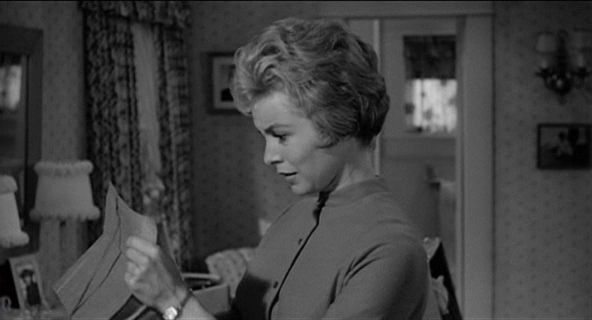
The POV shot is usually edited in such a way, that we’ll see firstly the character looking off screen and then the object the character is looking at, that is, his POV. This way of editing leaves no confusion whose POV it is. Here is a great example from Psycho.
Psycho (1960)Psycho (1960)Psycho (1960)
The POV shot helps us to identify with the character, even if we don’t like him, like in the final scene of The Silence of the Lambs.
Most of the time, the POV shots are used in a connection to beings, who are alive (people, animals), but only very rarely you’ll see a POV shot of a thing (chair, table), because it doesn’t usually make any sense, unless its alive, right? Like in the movies from Pixar, where you’ll have hundreds of POV’s of various toys, fish, cars, bugs, monsters, robots etc.
POV in IKEA commercial
So, when I see a POV shot, I automatically presume that it comes from a live being. And when you are alive, you can breathe, smell, you can feel, you can experience emotions, and you have also the ability to recognize feelings that are being experienced by another beings.
That’s why I felt sad for the lamp, when I saw it on the street, standing in the rain and wind next to the garbage can, looking back at the window, where it used to stand and shine.
How about you, did you feel sad for the lamp as well, or was it just me? 🙂
Always show, don’t tell! (Unless you are Alan Ball, remember? 🙂 ) Today, I’ll show you a perfect example of that “always show, don’t tell” rule. The movie was written by John Michael Hayes and directed by Alfred Hitchcock – the ultimate master of cinematic storytelling.
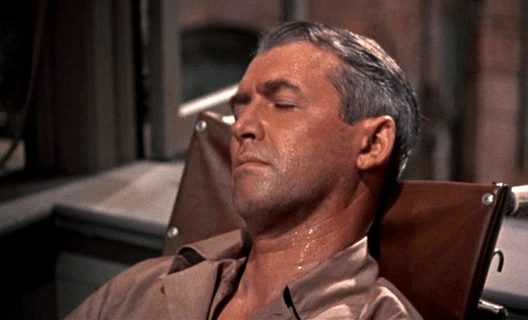
Quite early, we are introduced to the main character played by James Stewart. What is interesting though, is that the introduction happens through one single camera movement. Nice!
On imsdb.com, there is a script to Rear Window. I don’t know whether it is the original screenplay or just a transcript. Nevertheless, the opening scene is described there very nicely. So the following words are not mine, but the words found in Rear Window script.
Rear Window (1954)
The camera starts in the backyard, then pulls back swiftly and retreats through the open window back into Jefferies’ apartment. We now see more of the sleeping man. The camera goes in far enough to show a head and shoulders of him. He is sitting in a wheelchair.
Rear Window (1954)
The camera moves along his left leg. It is encased in a plaster from his waistline to the base of his toes. Along the white cast someone has written “Here lie the broken bones of L. B. Jefferies.”
Rear Window (1954)
The camera moves to a nearby table on which rests a shattered and twisted Speed Graphic Camera, the kind used by fast-action news photographers.
Rear Window (1954)
On the same table, the camera moves to an eight by ten glossy photo print. It shows a dirt track auto racing speedway, taken from a point dangerously near the center of the track. A racing car is skidding toward the camera, out of control, spewing a cloud of dust behind it. A rear wheel has come off the car, and the wheel is bounding at top speed directly into the camera lens.
Rear Window (1954)
The camera moves up to a framed photograph on the wall. It is a fourteen by ten print, an essay in violence, having caught on film the exploding semi-second when a heavy artillery shell arches into a front-line Korean battle outpost. Men and equipment erupt into the air suspended in a solution of blasted rock, dust and screeching shrapnel. That the photographer was not a casualty is evident, but surprising when the short distance between the camera and the explosion is estimated.
Rear Window (1954)
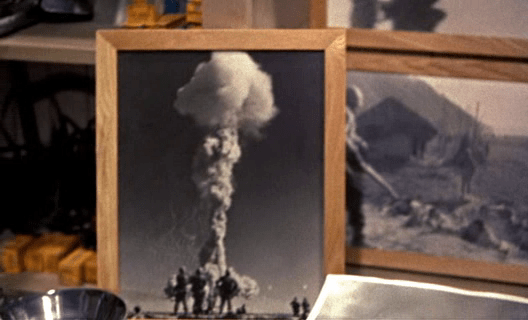
The camera moves to another framed picture, this one a beautiful and awesome shot of an atomic explosion at Frenchman’s Flat, Nevada. It is the cul-de-sac of violence. The picture taken at a distant observation point, shows some spectators in the foreground watching the explosion through binoculars.
Rear Window (1954)
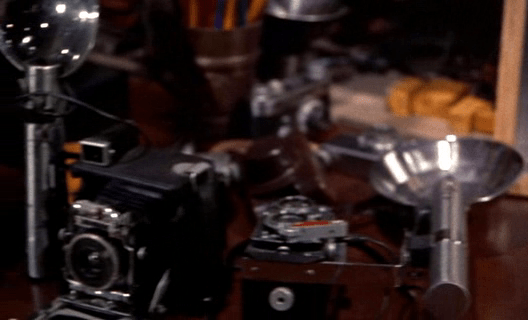
The camera moves on to a shelf containing a number of cameras, photographic film, etc.
Rear Window (1954)
It then pan across a large viewer on which is resting a negative of a woman’s head.
Rear Window (1954)
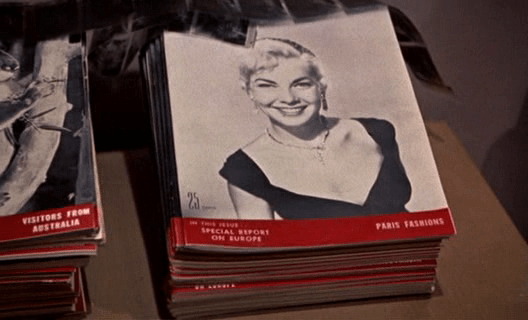
From this, the camera moves on to a magazine cover, and although we do not see the name of the magazine, we can see the head on the cover is the positive of the negative we have just passed.
From this, the camera moves on to a magazine cover, and although we do not see the name of the magazine, we can see the head on the cover is the positive of the negative we have just passed.
So through that one single camera movement, we know:
where we are
who is the main character
his name
his profession
all about his work
what caused the accident
Now, that is a very cinematic introduction of the main character through one single camera movement, not a single frame was wasted. And here is what Alfred Hitchcock said himself about this opening scene:
That’s simply using cinematic means to tell a story. It’s a great deal more interesting than if we had someone asking Stewart: “How did you happen to break your leg?” And Stewart answering: “As taking a picture of a motorcar race, a wheel fell off from one of the speeding cars and smashed into me.” That would be the average scene. To me, one of the cardinal sins for a script-writer, when he runs into some difficulty, is to say: “We can cover that by a line of dialogue.” Dialogue should simply be a sound among other sounds, just something that comes out of the mouths of people whose eyes tell the story in visual terms.
The paragraph above comes from a book called simply Hitchcock. It’s a collection of interviews between Alfred Hitchcock and François Truffaut and I have to tell you, this is such a beautiful book! ♥
It’s a journey into the world and history of cinema, Hitchcock’s personal life and first of all, a unique look at his films. Can’t wait to read that book again, and again, and then again!






 CINEMA SHOCK