Updated 14 July 2014
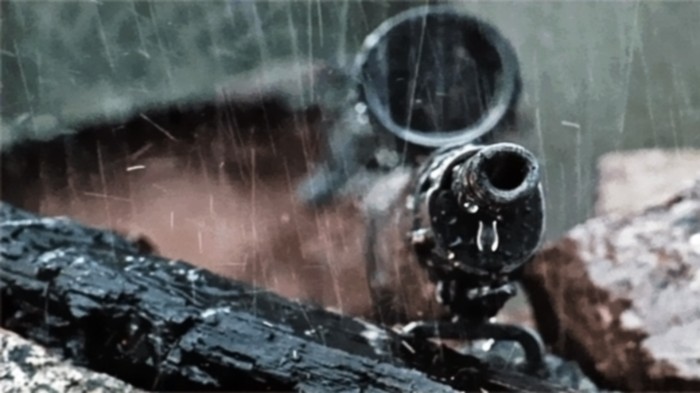
You can also see several explosions, and Janusz came up with the idea of shooting with the shutter open to 45 degrees or 90 degrees, which completely negated any blurring. Often, when you see an explosion with a 180-degree shutter it can be a thing of beauty, but a 45-degree shutter looks very frightening. [STEVEN SPIELBERG]
There used to be a YouTube channel called OrangTelorTheatre – lots of great stuff, including a 20 sec excerpt, where cinematographer Janusz Kaminski talks about shutter degree used in film Saving Private Ryan. Unfortunately, the channel doesn’t exist anymore.
There were two really exciting things in the video excerpt:
- Firstly, it is an example of cinematic storytelling – using a shutter degree to help to tell a story
- Secondly, when he talked (and let me remind you, he is a cinematographer) about what they did and why, he used a musical term – staccato
I just love people interested in various areas and disciplines, who are able to meaningfully connect those areas and draw similarities (like Walter Murch does, when he talks about three fathers of cinema).
(If you know how shutter works and what it does, feel free to skip the following part and jump to the Why section.)
Shutter
To understand how shutter works, I’ll be talking about shutter found in film cameras, because it’s a mechanical part and everything will be clearly visible and understandable, as opposed to a video camera, where shutter is an electronically controlled device and there is not much to see.
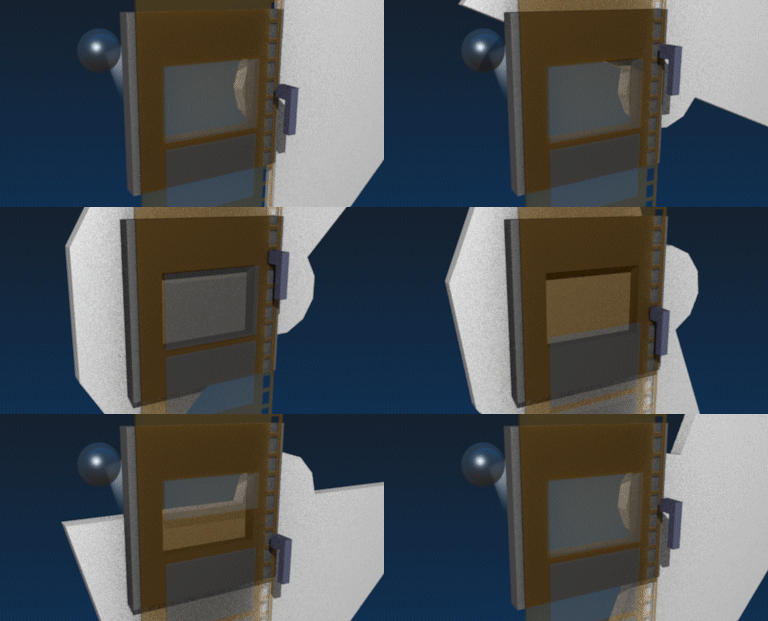
As you can see in the animation above, shutter is a rotating semi-circle in front of the film. As it rotates, half the time light can get through (film gets exposed) and half the time, light gets blocked (so the camera can move the film onto next frame). This particular shutter is the standard 180 degree shutter, but more about shutter degrees in the following section.
Film frame rate
The standard film rate is 24 frames per second. So when using the standard 180 degree shutter, the frame gets exposed for 1/48 of a second. (Just theoretically, if there was no shutter, one frame would be exposed for 1/24 of a second, but since there is a 180 degree shutter – blocking light half of the time – the frame gets exposed for only 1/48 of a second).
Shutter degree
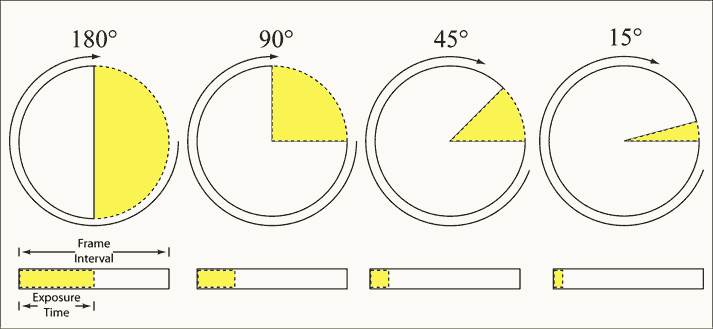
Physically, the film cameras can’t have the shutter bigger than 180 degree, because that’s the time needed to move the film. On the other hand, it can have shutter angle smaller than 180 degree. So you can have a 90 degree shutter, 45 degree shutter or even smaller.
As a quick side note, electrical shutter works very similarly, it controls for how long the digital sensor collects the light. But there is no limitation in terms of time, you can have the shutter open for even several seconds (which is technically not possible in case of film cameras). Also, in case of electrical shutter, we don’t talk about shutter degree, but about shutter speed.
Nevertheless, in both cases, you have to be aware, what it does, what it affects and influences, and there are two very important things (influenced by shutter): Light and Motion (blur).
Light
Shutter is one of the two things (the other one is aperture), which control the amount of light hitting the film (or digital sensor). The bigger the shutter degree, the longer the film frame is exposed to light and the more brighter it is.
It is also good to know, that every time you half the shutter degree (from 180 to 90 to 45 etc.), you are losing one F stop of light. In other words, the smaller the shutter degree is, the less light is hitting the film (or digital sensor) and the darker the image gets.
At this point, we know, what shutter degree does to light, so let’s take a look what it does to motion.
Motion (blur)
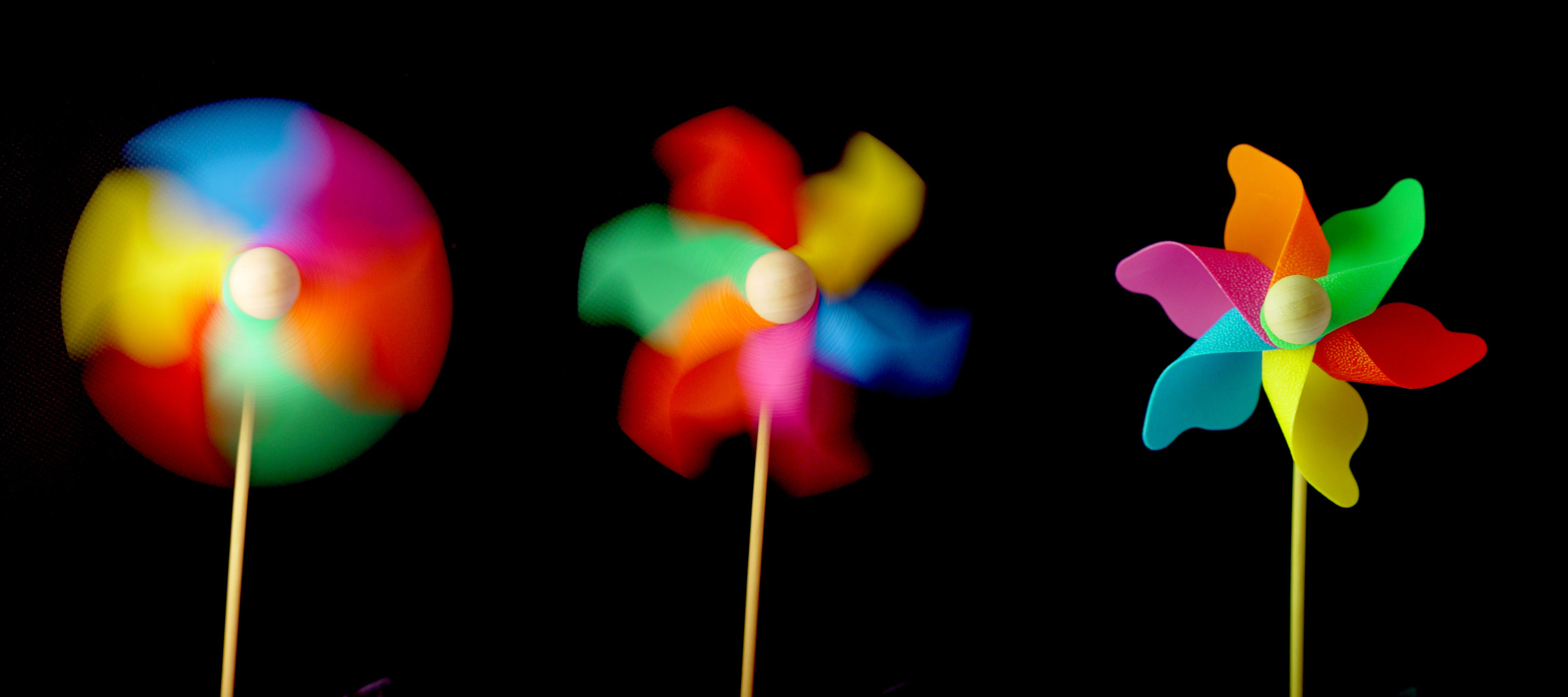
I want you to look back at the previous picture with shutter degrees and then at the picture above, because these two images are connected.
We can see a vane with colorful blades, but I want you to focus only on the yellow blade. As the shutter degree gets smaller and smaller (from left to right), the yellow blade gets less and less blurry, here is why: The bigger the shutter degree, the longer time a film frame is exposed to light and the greater distance an object in question (in this case yellow blade) can travel across the frame during that time (introducing thus the motion blur).
On the other hand, the smaller the shutter degree, the shorter time a film frame is exposed to light and the shorter distance a particular object can travel across the frame during that time (resulting thus in minimal motion blur).
The vane on the right was taken with a very small shutter degree and you can see what effect it has – it kind of freezes the motion. The yellow blade doesn’t basically move across the frame, because it is exposed to light for just a fraction of time and thus stays basically on the same spot (=almost no motion blur).
At this point, the technical part is finally over and now comes the best and my most favorite part – asking why? Why would you change the shutter degree?
Why
Well, let’s quickly remind ourselves what Janusz Kaminski said at the beginning in the 20 sec excerpt:
By applying 45 degree shutter, we are achieving certain staccato in actor’s movement. We are achieving certain crispiness of explosions. Everything becomes slightly, just slightly more realistic.
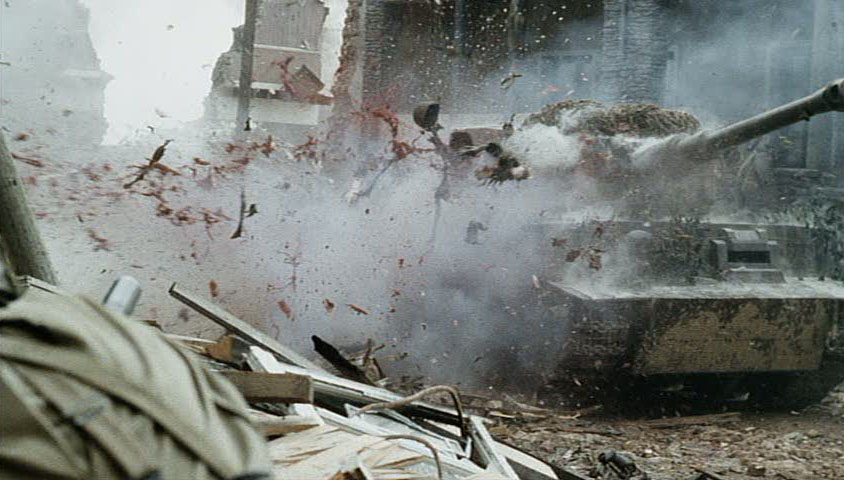
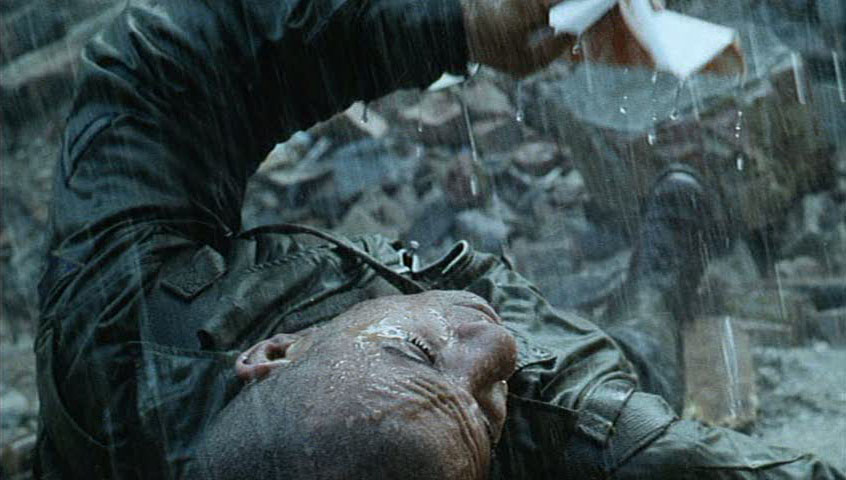
..I used a 45-degree shutter on the explosions, and a 90-degree shutter on most of the running shots. But we alternated at times. Sometimes the 45-degree shutter would appear too exaggerated and the 90 turned out to be better. But for extreme explosions like this, where we really wanted to practically count each individual particle flying through the air, the 45-degree shutter worked best. [STEVEN SPIELBERG]
So thanks to small (45) shutter degree, you can actually see debris, dirt and various particles flying in the air during explosions. But not just this, you can also see individual rain drops when it is raining. (With bigger shutter degree, you would see them as well, but they would be more blurred.) This is what he meant by the word crispiness and added sense of realism.
Small shutter degree means also that the motion is more chopped and stuttered – the film is exposed for such a small fraction of time, that the object almost doesn’t move across the frame when it is exposed to light. But in reality, the object moves of course, so when we see the next frame, the object kind of jumps to somewhere else (especially if it is moving fast), in other words, the movement is not fluent (=there is less of the motion blur). This is what he meant by the staccato in actor’s movement (staccato is a musical term, which dictates to play the notes very shortly and leave pauses between them). However, the effect of small shutter degree is very subtle.
And quite honestly, I didn’t notice this effect until I learned something about shutter degrees. And even after that, it took me some time to notice it. But that’s the beauty of it, it’s there, but hidden and telling the story on the emotional level.
Summary
Go almost always for the 180 degree shutter (that is, 1/50 if you shooting 25 frames per second, 1/48 when 24 fps, 1/60 when 30 fps etc.). This is the perfect looking natural looking film blur, something we’ve been seeing for so many years, something we are used to and like a lot.
If you want to add a subtle sense of realism, go for a smaller shutter degree (or faster shutter speeds, in 24 fps that would be from 1/48 to 1/60, 1/120 etc.) resulting in lower amount of the motion blur.
On the other hand, if you go for a dreamy look (or feeling you are on drugs, confused, you name it), you can experiment with slower shutter speeds like 1/24, 1/12 etc., adding thus more of the motion blur (this concerns only video cameras though).
P.S. I really love the idea of talking about shutter degrees in terms of musical articulation: Staccato for smaller shutter degrees (stuttered motion/movement) and legato for bigger shutter degrees (fluent motion/movement). If I were Walter Murch, I’d write a beautiful blog post, even book about it.
Links
Rotary Disc Shutter (Wikipedia)
Shutter Speed (Wikipedia)
180 Degree Shutter – Learn It, Live It, Love It
Shutter Speed vs. Shutter Angle
War Is Hell
FxGuide podcast (They start talking about shutter in twenty-minute.)

 CINEMA SHOCK